Investing 101: How to Start With Just $50
When I started investing, I didn’t have thousands sitting in a bank account. I had debt, bills and a ton of self-doubt. I’d assumed investing was for people who already had money, and that I’d start once I was “making more.”
You don’t need to wait for that. $50 is enough to get started. What decides how it goes is less about the amount and more about three things most beginner guides skip past: what kind of account it’s in, what you pay in fees, and whether you keep adding.
This post is about those three things. It doesn’t tell you what to buy.
Can you start investing with $50?
Yes. Many brokerages now have no minimum to open an account, and most let you buy a slice of a share (a “fractional share”) for $1 to $5. So $50 can be spread across a fund or a few companies. The amount isn’t the hard part. Fees, the account type and keeping it going are.
First, where does the $50 come from?
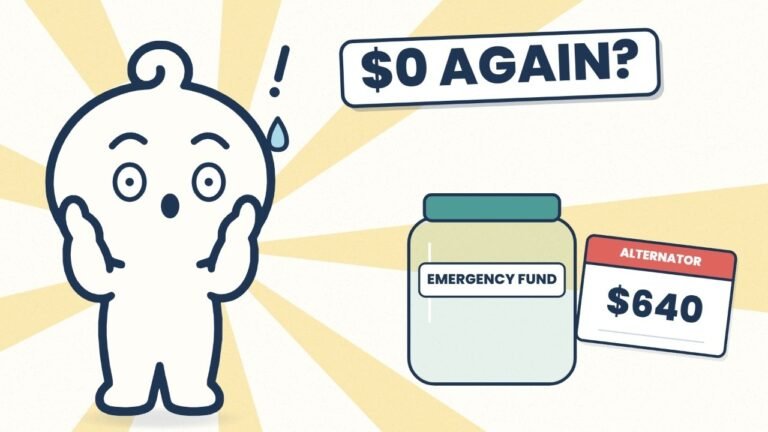
This is the step people skip, and it’s the one that decides whether $50 a month lasts past March.
If the money comes from “whatever’s left at the end of the month,” some months there won’t be any. It’s steadier to find a specific $50 that’s already leaving your account for something you don’t care about. For a lot of people that’s sitting in their subscriptions: a streaming service they forgot, an app that went up in price, a membership they stopped using.
Our free statement checker reads your bank statements on your own device and lists those, with what each costs a year. If it finds $50 a month, you’ve found the money without cutting anything you’d miss.
The two kinds of account
Before anything gets bought, the money needs somewhere to live. For most people starting out, that’s one of these two.
A Roth IRA
A retirement account. You put in money you’ve already paid tax on, and what it grows into can come out tax-free in retirement (after age 59½, once the account is at least five years old).
- Yearly limit: $7,500 for 2026, or $8,600 if you’re 50 or older (IRS).
- Income limit: for single filers, how much you can put in starts shrinking at $153,000 of income and stops at $168,000 in 2026. It’s higher for married couples.
- You need earned income (a paycheck or self-employment), at least as much as you put in.
- What you put in can come back out at any time without tax or penalty. It’s the growth that has to wait.
I opened my Roth IRA with $100. These days $100 moves into it from my checking account every week, automatically, and I don’t have to think about it.
A regular brokerage account
No yearly limit, no income limit, and you can take money out whenever you like. The catch is tax: you pay it on dividends each year and on gains when you sell.
If you have a job with a 401(k)
Some employers add money to your 401(k) when you put some in, called a “match.” It’s money you only get if you contribute, so it’s worth checking your benefits page to see if yours does, and how much.
What fees do to $50
Fees matter more on small amounts than on big ones, because some of them are flat.
Some beginner apps charge a flat monthly fee, often $3 or more. I started on one of those. On a $50 monthly deposit, $3 is 6% of everything you put in. Over a year that’s $36 in fees on $600 invested, before the market has done anything.
Funds charge differently: a yearly percentage of what you hold, called the “expense ratio.” The big S&P 500 index funds charge as little as 0.03% a year. On $600, that’s 18 cents. The average index stock fund charges about 0.45% (Investment Company Institute), or $2.70 a year on $600.
Same $600. $36 in one setup, 18 cents in another. Before you put money anywhere, find the fee line. It’s usually called the expense ratio, plus any account or monthly fee.
What an “index fund” is
You’ll see this term everywhere. An index fund is one fund that holds every company in a list, so you own a small piece of all of them at once. An S&P 500 index fund, for example, holds the 500 biggest US companies. If one company does badly, it’s one of 500.
There are other kinds of investment too (single stocks, bonds, target-date funds). I’m not going to tell you which to pick. That’s your call, and it depends on things only you know.
What history says about small, steady amounts
I ran $100 a month through every year of US market history since 1928 in What Happens If You Invest $100 a Month? 98 Years of Real Data. Halve the numbers for $50:
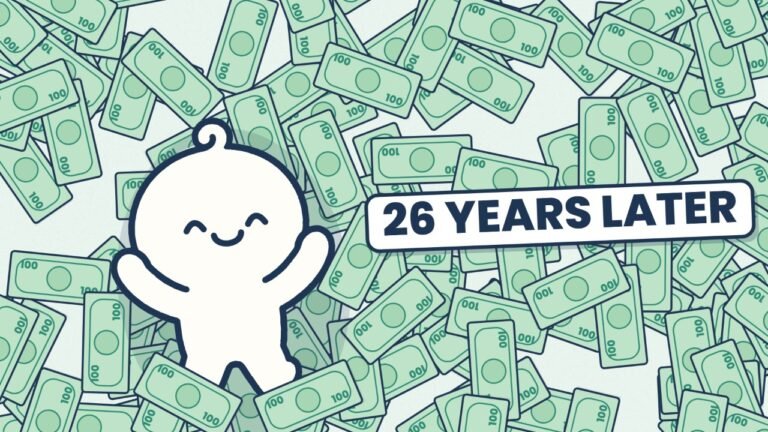
- Over 40 years, $50 a month ($24,000 put in) typically came to about $123,000 in today’s money. The worst 40-year start still ended near $78,000.
- About one year in four ended negative. Short stretches can go badly.
- Over 20 years, only 3 of 79 start years ended behind what was put in.
That’s the past, not a promise. The older version of this post showed a smooth 8% a year turning $50 a month into $146,815. Real markets don’t move in a straight line, and dollars 40 years from now won’t buy what they buy today. The real-history numbers are the more honest ones.
The part that’s actually hard
Keeping going. The first time your balance drops below what you put in, every part of you will want to stop.
When it happened to me, I stopped looking at the account instead. The automatic deposits kept going in, and I wasn’t there to talk myself out of it. That did more for me than anything I read.
So if you start with $50, the useful questions are boring ones. Is it automatic? Do you know what the fees are? Is this money you won’t need for a long time? (Money for a car or a deposit next year is a different case. A crash at the wrong moment can’t hurt money that isn’t in the market.)
I’m building Epiphany Money, a personal finance app that shows all your accounts in one place and tells you in plain sentences what’s safe to spend and where your money is leaking.
This post is general education, not financial advice, and no fund, app or company is recommended.