The One Emergency Fund Mistake That Keeps Sending It Back to Zero
If your emergency fund keeps going back to zero, you’re probably making the most common emergency fund mistake: paying for two kinds of cost out of one pot. One is real surprises. The other is bills you know are coming but can’t put a date on. Car repairs, the yearly insurance bill, a phone that dies. Give those their own pot, and the emergency fund finally gets the chance to grow.
That’s the whole idea. The rest of this post is the numbers behind it, and how to work out what your second pot should get each month.
I made a video about this where my cartoon character Epi watches his emergency fund hit zero for the third time in a year:
This post goes further than the video. You get Epi’s full year line by line, a list of the bills with no date that catch most people, a way to size your own pot, and what I actually do with my own money (it’s not quite what the video says).
Epi’s year: $900 saved, $0 left
Epi starts January with $1,200 in his emergency fund and adds $100 a month. Every money video told him the same thing: save it, and only touch it in an emergency. So that’s what he does.
| Month | What happened | Cost | Fund after |
|---|---|---|---|
| January | Starting balance | $1,200 | |
| March | New tires | $560 | $840 |
| June | Dropped phone | $280 | $860 |
| August | Yearly car insurance bill | $700 | $360 |
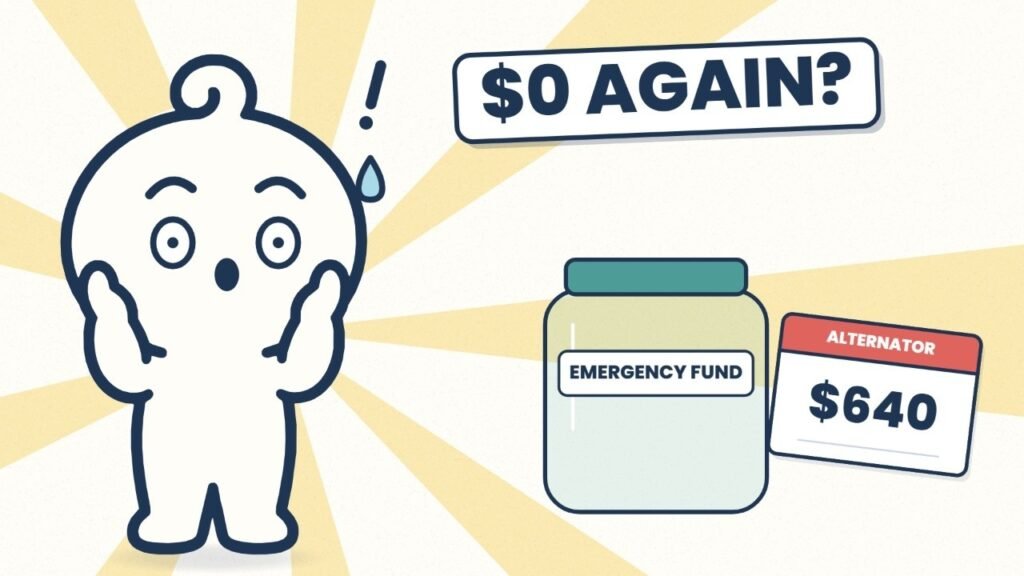
| October | Alternator | $640 | $0, plus $80 on his card |
(The “fund after” column includes his $100 deposits along the way.)
He put in $900 over the year and ended it below zero. Every one of those felt like an emergency on the day it arrived. Even the insurance bill, which comes every August and which he, honestly, forgot about.
Why does my emergency fund keep going back to zero?
Epi isn’t unusual. In Bankrate’s 2026 emergency savings survey, taken in December 2025, 58% of Americans said their emergency savings hadn’t grown over the past year. Half of those (29% of everyone) said it had gone down. Only 47% could cover a $1,000 emergency from savings.
Then look at how people actually spend it. In an earlier Bankrate survey, 37% had dipped into their emergency savings in the past year. About half of those used it for a surprise bill like a car repair or a doctor. But 38% used it for regular monthly bills like rent or electricity, and 32% for everyday things like groceries.
I want to be fair here: for a lot of families that isn’t a mistake. When the rent is short, the rent is the emergency. That’s exactly what the money is for.
But it shows how most emergency funds die. Not in one big crash. A bill at a time.
The bills aren’t really surprises
Here’s the number that changed how I think about this. The Federal Reserve’s report on household finances in 2025, published in May 2026, asked about big unexpected expenses for the first time in this detail. 59% of adults had at least one in the past 12 months.
The most common:
- Major car repair or replacement: 30% of adults
- Home or appliance repair: 22%
- Major medical costs: 21%
For each of those, the typical bill was between $1,000 and $1,999.
Now do the math on that 59%. If about six in ten people get hit in any given year, the chance of getting through three years in a row with nothing at all is about 0.41 × 0.41 × 0.41, or roughly 7%.
Flip that around: over three years, a big “surprise” is about 93% likely. What isn’t known is the month. I know my car will need work. I don’t know if it’s March or October. That’s not an emergency. It’s a bill with no date on it.
And if you pay every one of those from the emergency fund, it never gets big enough to handle the real thing.
Sinking fund vs emergency fund: what’s the difference?
A sinking fund is money you set aside for a cost you know is coming, even if you don’t know exactly when. An emergency fund is for things you can’t plan for at all: losing your job, a hospital stay, anything too big for the first pot.
The simplest way to tell them apart: if you can name the cost before it happens (“the car,” “the vet,” “Christmas”), it belongs in the sinking fund. If you can’t even guess what it would be, that’s what the emergency fund is for.
Epi calls his sinking fund the “it’ll happen” fund. I like that better, because it says what the money is for.
| “It’ll happen” fund (sinking fund) | Emergency fund | |
|---|---|---|
| Pays for | Costs you know will come, date unknown | Things you can’t plan for |
| Examples | Car repairs, yearly insurance, new phone, gifts, vet | Losing your job, hospital bill, a big repair that’s more than the first pot holds |
| How it’s sized | Add up a normal year, divide by 12 | Start with $2,000 or half a month of expenses, build toward 3 to 6 months |
| Should it go up and down? | Yes, that’s its job | Rarely |
How to stop your emergency fund from being drained: 4 steps
1. List your bills with no date
Sit down with last year’s bank and card statements and pull out every cost that comes around once a year or every few years. These are the ones people forget most:
- Car: repairs, tires, oil changes, registration, the yearly or six-month insurance bill
- Home: appliance repairs, the deductible on renters’ or home insurance, a new mattress
- Health: dental work, glasses or contacts, the part of a doctor’s bill insurance doesn’t cover
- Tech: a new phone every few years, a laptop
- People: birthdays, December gifts, a wedding you’ll be invited to
- Pets: the vet, yearly shots
- Subscriptions billed once a year (these hide well, because you only see them every 12 months)
If going through statements by hand sounds painful, our free statement checker reads your files right in your browser and lists the bills and subscriptions it finds. Nothing gets uploaded.
What goes wrong: people list the costs they remember from the last few months and miss the yearly ones. The yearly ones are exactly the ones that empty the fund.
2. Put a yearly number on each, and divide by 12
Here’s Epi’s list:
| Bill with no date | A normal year |
|---|---|
| Car repairs and tires | $900 |
| Car insurance (yearly bill) | $700 |
| New phone (about $900 every 3 years) | $300 |
| December gifts | $500 |
| Total | $2,400 |
| Per month | $200 |
For costs that come every few years, divide the price by how many years it usually lasts. For car repairs, use what you actually spent the last couple of years, not what you hope to spend.
What goes wrong: this number is usually bigger than people expect. Epi’s was double what he was saving. That feels bad for about a minute, until you notice he was already paying it. This year it came out of his emergency fund and went onto his card.
3. Give each pot its own name
In a study in Ghana, just putting a label on a savings account raised deposits by about 30%. Same money, same bank. The only change was a name telling people what the money was for.
The video says to give each pot its own account. That’s the cleanest way, and many online banks let you open a second savings account for free and name it. (I do it a bit differently. More on that below.)
What goes wrong: the “it’ll happen” fund sits in your checking account “in your head.” It won’t stay there. Money in checking gets spent.
4. Decide now what counts as an emergency
Write down, before you need it, what the emergency fund is for. Something like: losing my job, a medical bill, or anything bigger than what the “it’ll happen” fund holds right now.
When the alternator goes, it comes out of the “it’ll happen” fund and the emergency fund doesn’t move.
The opposite mistake: never touching it
Epi’s friend Benji heard all of this and crossed his arms. Benji never touches his emergency fund. He has $3,000 in it and he’s proud of it.
Last month his water heater broke: $1,000. He put it on his credit card, to protect the fund.
That’s the same problem, from the other side. Credit cards charge about 19.65% on average right now (Bankrate’s figure). Paying $50 a month, that $1,000 takes 25 months to clear and costs about $221 in interest. Meanwhile his $3,000 sits in savings earning far less than that.
If he’d used the fund, he’d have $2,000 left and no card bill. Economists have a name for people who carry card debt while sitting on savings: the credit card debt puzzle. It’s common enough that it got a name.
The rule: use it when you need it. Then refill it before you save for anything extra.
How much should be in your emergency fund?
You’ll see “3 to 6 months of expenses” everywhere, and it sounds huge when you’re starting from zero. Vanguard says that too. But read the rest of Vanguard’s page: 3 to 6 months is for losing your income. For spending surprises like a car repair, Vanguard suggests starting with $2,000 or about half a month of expenses.
That’s two different targets for two different problems, which is the same split as the two pots.
The smaller number matters more than it looks. Vanguard surveyed more than 12,000 of its investors: the ones with at least $2,000 set aside for emergencies scored 21% higher on financial well-being than those with nothing, and spent about half as much time each week dealing with money. The Fed’s report found something similar from the other direction: of the adults who had a big unexpected expense, 41% went through some kind of financial hardship that year, compared with 28% of those who didn’t.
So a reasonable order:
- $2,000 (or half a month of expenses) in the emergency fund
- The “it’ll happen” fund getting its monthly amount from the start, alongside step 1
- Then build the emergency fund to 3 months of expenses
- Then 6, if your job or income is less steady
Epi’s new plan: $200 a month to the “it’ll happen” fund and $100 a month to the emergency fund. Next time the alternator goes, he’s not starting over.
What I actually do
The video tells you to give each pot its own account. I don’t, quite.
I keep one savings account and track the split myself: how much of it is for bills with no date, and how much is the real emergency fund. When a car bill comes, it comes off the first number, and the second one doesn’t move.
That works for me because I actually keep the split up to date. If you know you won’t, separate accounts are the safer choice, because the bank does the remembering for you. What matters is that you can look at your savings and say what each dollar is for. One big number with no split is how Epi ended up at zero.
The question to ask yourself
How many of your emergencies last year were really bills with no date?
Go through them. If you could have named it in January, it wasn’t an emergency. It just didn’t have a date yet.
If you’re saving with a small amount each month, my post on saving $10K without side hustles might help too. And if you’re wondering where money goes once the emergency fund is full, what happens if you invest $100 a month covers why money you’ll need soon belongs in savings, not the market. More like this in Guides.
I’m building Epiphany Money, a personal finance app that shows all your accounts in one place and tells you in plain sentences what’s safe to spend and where your money is leaking. Join the waitlist if that sounds useful.
This post is general education, not financial advice.