5 Money-Saving Habits That Don’t Run on Willpower

Most lists of money-saving habits are really lists of things to resist: the coffee, the takeout, the cart full of stuff at 11 p.m. That works for about a week.
The habits below are different. Each one is set up once, or checked now and then, and then it keeps saving while you get on with your life. None of them asks you to become a different person.
What are the best money-saving habits?
The money-saving habits that last are the ones that don’t depend on willpower: plan from what you actually spent last month, move savings out on payday automatically, check for forgotten subscriptions and price increases, keep money for expected bills apart from your emergency fund, and re-shop your biggest bills once a year.
Here’s each one, with what tends to go wrong.
1. Plan from last month, not from a template
The usual advice is to write a budget: $400 for groceries, $150 for eating out, done. Then the month happens, and the numbers on paper have nothing to do with the numbers on your card.
Start the other way round. Pull up last month’s transactions and add up what really went where. Most people are surprised by one category. Eating out is the usual one. Say you’d have guessed $150 and it was $420. Now you know where the room is, and a plan of $300 is believable. A plan of $150 isn’t, and you’ll stop looking at it by the 10th.
What goes wrong: picking a month that wasn’t normal. A month with a vacation or a car repair in it makes everything look worse than it is. Use three months if you can, and look at the middle one.
2. Save on payday, before you see the money
Set up an automatic transfer from checking to savings for the day after your paycheck lands. Even $25 counts. The amount matters less than the timing: money that leaves on payday never sits in your checking account looking like it’s available.
This is the “pay yourself first” idea, and it’s popular because it works without effort. You don’t decide to save each month. You’d have to decide not to.
What goes wrong: setting the amount too high, overdrawing once, and switching the whole thing off. Start lower than feels impressive. You can raise it in two months when you’ve seen it doesn’t hurt.
3. Check for leaks every few months
Leaks are the charges you agreed to once and forgot about: the app you tried for a week, the streaming service that went up a dollar, the gym you stopped going to. They’re small, they repeat, and they don’t show up when you only look at your balance.
People are bad at guessing this number. In a 2022 survey by C+R Research, people guessed they spent $86 a month on subscriptions. When they went through their statements, it was $219.
Three kinds of leak worth looking for:
- Forgotten subscriptions. A $2.99 charge you never think about is $36 a year.
- Price increases. Services raise prices quietly and keep charging the card on file. $10.99 becoming $11.99 doesn’t sound like much until you count every service you have.
- Double charges. The same amount, from the same store, on the same day. It happens more than you’d think, and the store will usually refund it if you ask.
You can find all three by reading three months of statements line by line. Or drop your statements into our free statement checker, which reads them on your own device and lists the subscriptions, price increases and double charges it finds. Nothing gets uploaded.
What goes wrong: cancelling things you actually use because a list made you feel guilty. Leaks are charges you’d say no to if someone asked you today. If you’d say yes, it’s not a leak.
4. Keep bill money out of your emergency fund
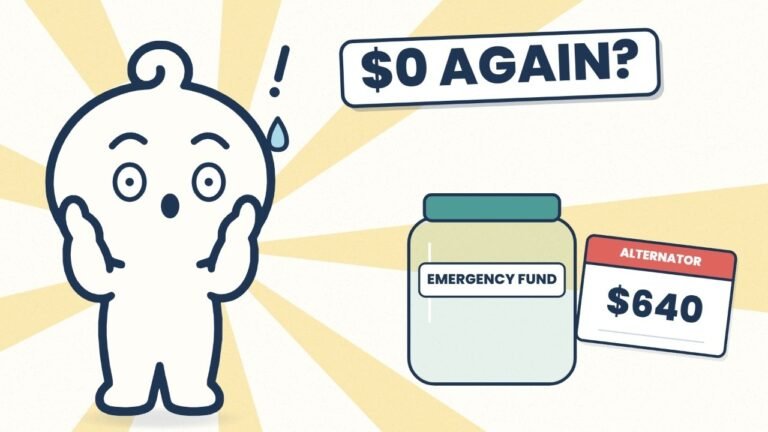
If your emergency fund keeps going back to zero, look at what it’s being spent on. Often it’s not emergencies. It’s the car registration, the annual subscription renewal, the holiday gifts. Those aren’t surprises. They’re bills that come once a year.
Give those expected costs their own savings pot, and add a little to it every month. Then the emergency fund is left for actual emergencies, and it gets to grow. I wrote a whole post on the emergency fund mistake that keeps sending it back to zero, with the numbers.
What goes wrong: forgetting the yearly ones. Go back through twelve months of statements and write down anything that only showed up once or twice. That’s your list.
5. Re-shop your biggest bills once a year
Car insurance, phone, internet. These bills tend to creep up at renewal, and the companies count on you not checking.
Once a year, get two other quotes for each one. Sometimes you switch. More often you call your current company, tell them what the other quote was, and they find a lower price. It’s twenty minutes on the phone for something you pay every single month.
What goes wrong: only comparing the price. Check that the new quote covers the same things, especially with insurance.
Why these five
Every one of these runs mostly on its own once it’s set up. The transfer happens on payday. The leak check takes an hour every few months. The bill pot fills itself. That’s the point: habits that need you to be disciplined every day are the ones that quietly stop.
If you want to see where your own money goes without doing it by hand, I’m building Epiphany Money, an app that puts your accounts in one place and tells you in plain sentences what’s safe to spend and where your money is leaking.